2 steps to Fixing IT Band Pain for Good
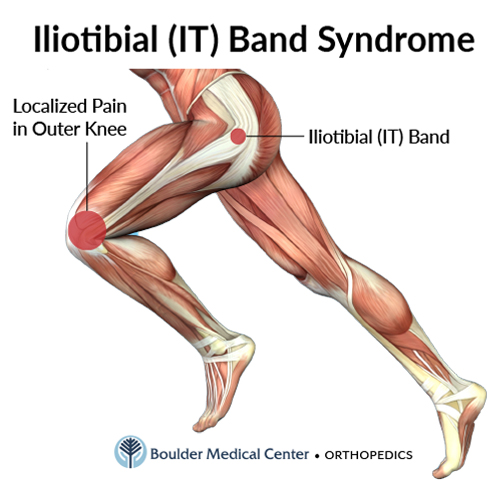
Focusing on the IT Band alone will not usually help resolve your pain. IT Band syndrome occurs when the hip doesn’t load or stabilize properly. Muscles will then pull unevenly on the IT band, leading to irritation near the knee and that persistent “tight” feeling along the thigh or outside of the knee.
If you want to learn more about what IT Band Syndrome is, read our blog: “IT Band Syndrome: why foam rolling isn’t helping”.
Foam rolling is not going to help your IT Band syndrome. We are going to give you our 2 step system to get to the root of your IT Band pain.
1. Target the Right Areas for Soft Tissue Work
Soft tissue work can be helpful, but it needs to be aimed at muscle, not dense connective tissue.

Lauren’s hand is holding the ball in the location you are targeting.
The side of the hip often holds a lot of tension, especially the tensor fascia latte (TFL) and gluteus medius. To find it, place your hand on the front point of your hip bone and slide slightly to the outside, where the front pocket is on your pants.
Instead of crushing yourself on the floor, try:
A tennis or lacrosse ball against a wall
Use only enough intensity where you can stay relaxed and breathe normally
If you’re holding your breath and bracing against pain, you’re not actually releasing tension, you’re reinforcing it.

The ball should be just above the bony side of your hip (not on it)
2. Learn to Load the Hip Properly
Releasing tension alone is never enough. Muscles tighten up when they’re forced to stabilize joints they aren’t strong enough to control.
To truly reduce IT band irritation, you have to restore strength, control, and coordination at the hip.
One of our favorite exercises for this is the kickstand hinge.
This movement:
Teaches the hip to move independently
Loads and lengthens the glute effectively
Improves force transfer through the foot and floor
Reduces compensatory tension at the IT band
When the glutes and lateral hip muscles can accept load well, the IT band no longer needs to absorb excess stress.
The Big Picture
IT band syndrome isn’t caused by a “tight” IT band - it’s caused by poor load management and poor stability at the hip.
Foam rolling the side of your leg may feel productive in the moment, but it doesn’t solve the underlying issue. The real solution combines:
Smarter soft tissue work (targeting hip muscles, not the IT band)
Strength and stability training for the hip
Better movement mechanics during running, lifting, and daily activity
When the hip does its job, the IT band stops complaining.
And that’s when the pain finally starts to go away.
Work with a Physical Therapist to help your IT Band Syndrome
If you live in Portsmouth, New Hampshire or the Seacoast of New Hampshire and want to work with a physical therapist that understands sports performance, we would love to help you at Anchor Physical Therapy & Performance. There are many hands-on manual therapy techniques including dry needling that can help reduce tightness around the IT Band. We can also help with your running gait form to help identify reasons why your IT Band gets tight and painful.
New Hampshire and Massachusetts Residents: we offer virtual physical therapy sessions where we can assess your movement and talk about ways you can address your IT Band syndrome and find relief quickly.